
From the El Dorado Springs Sun
A question about power in local government prompted El Dorado Springs Sun readers to discuss public trust, government oversight, and whether everyday citizens feel comfortable speaking up.
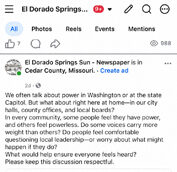 The newspaper’s Facebook poll asked, “Does power corrupt—even at the local level?” It opened Friday, Oct. 23, and at the newspaper’s 10:30 a.m. reporting cutoff Monday, Oct. 26, the Sun reported 91 responses: 77 yes, one no, and 13 saying it depends on the person and the accountability.
The voluntary online poll is not a scientific survey and does not establish wrongdoing by any official or office. It reflects the views of those who chose to participate. Voting remained open after the reporting cutoff, although comments were closed.
The original post asked readers whether some voices carry more weight than others and whether residents feel comfortable questioning local leadership—or worry about what might happen if they do.
A follow-up question in the comments brought the discussion closer to individual offices: “Which local office or governing body do you feel holds the most power—and gives everyday citizens the least say?”
James Shifflett answered, “All County Offices.”
The Sun asked him to explain that assessment, noting that the recorder, assessor, treasurer, county clerk, collector, and public administrator have different responsibilities than prosecutors, circuit clerks, sheriffs, and judges. The newspaper also asked about county commissioners and city officials, including police, council members, aldermen and mayors.
The questions sought firsthand examples of concerns being dismissed, intimidation, or officials acting above accountability. The Sun also asked whether such behavior extended beyond government offices into everyday community encounters.
“We’re asking for specifics because we want to understand where people feel powerless and why,” the newspaper wrote. “Please identify the office, describe the situation and explain how your concerns were handled.”
Shifflett responded that his answer concerned the public responsibilities of every office, rather than an accusation that he had personally witnessed wrongdoing in each one.
“Every county office holds a position of public trust, handles responsibilities that affect people’s lives, and should be subject to the same level of scrutiny as the citizens they serve,” he wrote.
He pointed to county audits as reasons to question oversight and ask what happens after deficiencies are identified.
A May 2025 Missouri State Auditor’s report gave Cedar County a “fair” rating. It found that Cedar County levied approximately $1.2 million in excess property taxes from 2020 through 2023 because of incorrect sales tax rollback calculations. Other findings included errors in the collector’s records, late public administrator settlements, and $11,719 in midterm sheriff’s salary increases that auditors found violated constitutional provisions.
The report also cautioned that a finding involving one county office does not necessarily apply to another. In its response, the county acknowledged the rollback errors and outlined plans to correct the overcollections. The county’s website later announced that it had mailed the first installment of repayments, covering 2020.
Shifflett also cited a financial audit released in May 2026. The report, prepared by McBride, Lock & Associates for 2022 and 2023, found missing evidence of monthly bank reconciliations, accounting discrepancies, and accounts not initially disclosed to auditors. In its published response, the county said software and cybersecurity problems had interfered with work between the treasurer’s and clerk’s offices. It reported addressing those problems and changing accounting systems.
Shifflett asked what consequences followed government failures, whether money had been recovered and what safeguards had been established.
“These are reasonable questions, and people shouldn’t have to fight their own government to get the answers,” he wrote.
He also questioned the handling of the Agape Boarding School investigation. The charging dispute he referenced became public in 2021, when the Missouri attorney general’s office recommended 65 criminal counts against 22 individuals and Cedar County Prosecuting Attorney Ty Gaither filed 13 third-degree assault counts against five staff members. At the time, Gaither told the Missouri Independent that his charging decisions reflected the evidence gathered during the investigation.
Beyond public records, Shifflett described personal experiences involving his family, law enforcement and the judicial system that he said had diminished his confidence in local institutions. He said he had documentation concerning portions of those experiences. Those materials were not included in the Facebook discussion supplied for this article, and his personal allegations have not been independently verified for this report.
His broader concern was that influence in a small community can discourage people from raising questions.
“A public position can give someone considerable influence in a small community, especially when nearly everyone knows everyone else,” he wrote.
He encouraged others to share their experiences and supporting documentation so concerns could be examined.
Other readers also expressed frustration with authority. Oliver Keith described concerns about utility billing and fear of retaliation for speaking publicly. Isaac Sebastian Miller argued that people with power can resist efforts to challenge corruption. Those comments reflected the writers’ views and did not establish misconduct.
The Sun thanked Shifflett for explaining his concerns. He subsequently permitted his response to be published.
“I think these are important conversations for our community to have,” he wrote.
The newspaper plans to run a weekly poll to give readers more opportunities to share their perspectives.
Editor’s note: The current county clerk, Chrislynn Price, and the county treasurer, Carla Lowe, were not serving in those positions during the years covered by the audit findings discussed in this article. Those findings concern their predecessors’ terms, not the current officeholders’ tenure.


Facebook Comments